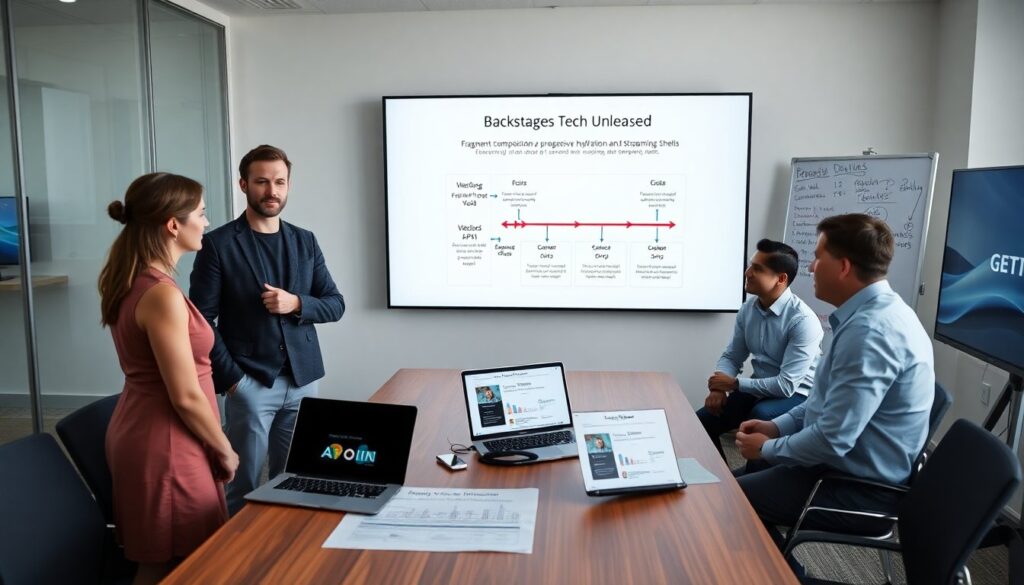
BackstagePage Tech Unleashed explains a new approach to page rendering and site orchestration. It speeds page load, reduces server cost, and improves user signals. The guide gives clear steps to evaluate, deploy, and measure the system. It stays practical for teams that publish content in English and want faster, cleaner web pages.
Key Takeaways
- BackstagePage Tech Unleashed boosts page speed and reduces server costs by moving non-critical tasks off the main rendering path, improving Core Web Vitals and user experience.
- The technology uses fragment composition, progressive hydration, and asynchronous sidecar services to deliver fast-loading, interactive pages with minimal payloads.
- Implementing BackstagePage Tech starts with piloting small fragments on high-traffic templates, emphasizing a tiny critical shell and effective caching strategies.
- Teams must set clear failure modes to ensure fragments fail gracefully without blocking main content, which maintains site stability and lowers operational risk.
- English-speaking sites should optimize for scanning by placing key headings and CTAs in the shell and localizing content efficiently.
- Observability, A/B testing, and security validation are essential to measure impact, monitor performance, and protect fragment data during rollout.
What BackstagePage Tech Is And Why It Matters For Modern Web Experiences
BackstagePage Tech Unleashed refers to a set of patterns and tools that move non-critical work off the main rendering path. It separates control, data fetching, and peripheral UI assembly from the initial render. The design goal reduces time-to-first-meaningful-paint and lowers perceived latency. Teams adopt this approach when they want predictable metrics and lower hosting bills.
It favors small stateless services that provide fragments or signals for pages. The main renderer composes those fragments quickly. This method keeps the critical path short. It also isolates slow third-party widgets so they cannot delay the main content. Engineers gain clearer ownership of each fragment and can test them independently.
BackstagePage Tech Unleashed matters because search engines and users reward speed and stable layout. It improves Core Web Vitals by shortening the longest task and reducing layout shifts. Marketers keep conversion funnels intact because pages show core content fast. Operations teams lower risk since a failing fragment no longer takes the whole page offline.
Core Features And How BackstagePage Tech Works Under The Hood
BackstagePage Tech Unleashed relies on three core features: fragment composition, progressive hydration, and asynchronous sidecar services. Fragment composition delivers pre-rendered pieces that the main template stitches together. Progressive hydration activates interactive code after the page shows. Sidecar services run optional work, like recommendations or analytics, off the critical thread.
The system uses a simple contract. Each fragment exposes a minimal marker and a data signature. The renderer fetches the marker and a small payload. The renderer then mounts the fragment into the page shell. The contract keeps payloads small and predictable. Teams can cache fragments independently and invalidate them by key.
It also uses streaming where possible. The server streams the shell first, then streams fragments as they arrive. Browsers paint the shell and show main text quickly. Scripts then hydrate interactive parts in the background. This flow reduces blocking scripts and shortens the longest task.
BackstagePage Tech Unleashed supports feature flags and gradual rollout. Teams enable fragments per cohort and measure impact. Observability instruments each fragment with timing and error labels. Engineers trace slow fragments and either optimize or move them further off the critical path.
Practical Implementation, Best Practices, And Next Steps For English-Speaking Sites
Teams start with a small pilot when they adopt BackstagePage Tech Unleashed. They pick a high-traffic template and move one widget to a fragment. They measure baseline metrics, then measure after the move. They keep the fragment API minimal and version it.
Best practice one: keep the critical shell tiny. The shell should include only the elements needed for meaning and navigation. Best practice two: cache fragment outputs with short TTL and allow stale-while-revalidate. Best practice three: instrument each fragment with timing marks and error counts.
Teams should also set clear failure modes. When a fragment fails, the shell must show a simple fallback. Teams must fail gracefully and avoid blocking the main content. They should test network failure, slow third parties, and expired caches.
For English-speaking audiences, teams must optimize copy and markup for scanning. They should place headings and the main CTA in the shell so users see them instantly. They should localize text strings and keep translations in a lightweight store.
Operational steps: add observability keys per fragment, run A/B tests that compare baseline pages with fragmentized pages, and monitor Core Web Vitals and conversion metrics. Security steps: validate fragment inputs on the server and sanitize outputs before insertion.
Teams can scale gradually. They can move search bars, sidebars, and recommendation modules into fragments first. They can leave critical content, like article text, in the shell. This order keeps risk low and impact high.
BackstagePage Tech Unleashed delivers faster pages and clearer ownership. It gives teams a path to measurable speed gains without a full rewrite. Teams that apply the pattern carefully can cut load time and improve key user metrics within weeks.